Is the Franklin Field safe for use this Spring 2016?
Should the replacement of this field be grass?
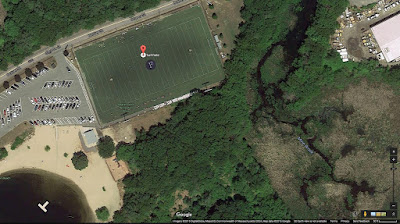 |
| Beaver Pond / Chilson Beach at 450 Beaver Street, Franklin, Massachusetts |
Located at 450 Beaver Street, the Synthetic Turf Field was installed sometime around 2003.
• The Beaver St. synthetic turf field is scheduled to be replaced in the next two years.
• If the council votes $200k this year, they will hire an architect to design and be ready in 2017 to build.
PROBLEM: The Beaver Street field is still slated for use in the spring of 2016
Precautions the Town of Franklin should take: GMAX testing and LEAD testing
QUESTIONS:
Who was the synthetic turf/carpet and in-fill material supplier for the Town of Franklin's Beaver Street Field?
Is the town liable or the manufacturer for maintenance which effects safety or warranty of the current field?
WHY GMAX and what is it?
You can read all the scientific details but simply put:
It is a test to measure the Surface hardness and applies to natural grass and synthetic turf.
GMAX is important because of the increased potential of concussions and
other injuries cause by impact on a hard surface.
Synthetic turf infill does settle and become compact. BUT, What is happening at Beaver Street and is MORE concern for safety and what is missing: the field is very void of any tire crumb rubber infill material that has disappeared over time. (it disappears through migration: players carry it home, it washes away and also breaks down / erodes over time)
While this infill material is questionable from a chemical standpoint. Tire Crumb Infill is the material that is supposed to cushion this field. As of January 2016 the field seemed VERY hard and is void of crumb rubber. There are also flooding issues as documented in the photos below.


It is assumed this all happened because:
• the "no maintenance" fallacy peddled by synthetic turf companies lead to the Town of Franklin doing "no maintenance" but, indeed, synthetic turf suppliers have full maintenance brochures full of additional equipment needed.
According to one supplier: www.fieldturf.com/maintenance
• GMAX testing multiple times a year to ensure a safe, properly cushioned surface
• Field brushing to keep synthetic carpet "grass" fibers standing/ keep from matting
• Field sanitation using harsh chemicals
Artificial
turf collects many unwanted ferrous objects. Metal objects are easily
deposited in synthetic turf, creating hidden dangers for the athletes
who use the field. Examples of artificial turf metal field contaminants
that are easily dropped in artificial turf fields are bobby pins, safety
pins, nails, instrument components, buckles and other metal objects
from uniforms or band costumes. The six foot tow behind the field magnet
will pull these metal objects up and out of the artificial turf.
Protect your athletes with this powerful field magnet for artificial
turf. - See more at:
http://www.sportsturfnw.com/field-magnet-for-artificial-turf/#sthash.bLDGPQ2r.dpuf
Artificial
turf collects many unwanted ferrous objects. Metal objects are easily
deposited in synthetic turf, creating hidden dangers for the athletes
who use the field. Examples of artificial turf metal field contaminants
that are easily dropped in artificial turf fields are bobby pins, safety
pins, nails, instrument components, buckles and other metal objects
from uniforms or band costumes. The six foot tow behind the field magnet
will pull these metal objects up and out of the artificial turf.
Protect your athletes with this powerful field magnet for artificial
turf. - See more at:
http://www.sportsturfnw.com/field-magnet-for-artificial-turf/#sthash.bLDGPQ2r.dpuf
Now for the important question:
WHY LEAD testing for Franklin? and HOW?
WHY LEAD testing for Franklin? and HOW?
WHY:
• Various Federal Agencies state: NO LEVEL of Lead is safe for Children
• The Beaver Street field was installed prior to the
 | |||||
| http://www.ceh.org/lead-in-artificial-turf/ |
The Center for Enviromental Health will screen your samples for free.
***************
Please watch their video about lead in TURF:
http://www.ceh.org/lead-in-artificial-turf/
***************
***************
Please watch their video about lead in TURF:
http://www.ceh.org/lead-in-artificial-turf/
***************
NOTE: CEH is a non-profit and donations are encouraged!
Sending in a sample is easy!
Your sample should consist of at least six blades. Collect any loose blades scattered on the turf surface. If those are not available, cut or pull some blades from an area of turf from an area that will not impact the usability of the field. Put the blades in a small bag (for example, a ziplock bag) or envelope. Some turf has two different blade types (often “straight” blades with “curly” blades underneath); if so, send us a sample of both. If there are lines or logos that are different colors you are welcome to send us a sample of each color. There is no charge for this screening. We will provide screening results within two weeks of receiving your sample.
Send samples to:
Center for Environmental Health
2201 Broadway, Suite 302
Oakland, CA 94612
Attn: Matt


