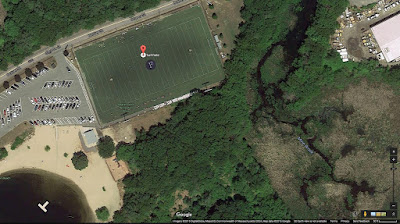
In 2012, Jim Novak wrote about Nano particles:
"The concern: Carbon black nanoparticles make up 30 per cent or more of car tires; the same tires that are pulverized for creating the tire crumb used on artificial turf playing fields and on playgrounds for children. Engineered carbon nanotubes and other engineered nanoparticles (zinc, titanium, etc.) are often made in specific shapes to give added strength and durability to tires and other goods. It is the long thin nature of engineered carbon nanotubes that has some scientists drawing a comparison between the possible health hazards of tire crumb with asbestos."
https://www.turfandrec.com/exposure-to-crumb-rubber-nanoparticles-could-lead-to-serious-health-issues-researchers-2986/
Here is a compilation of information on carbon nanotubes:
- New! 12-8-19: “The Technical Report states that given the long half-life and persistence of MWCNT in the lung, even short periods of exposure at such levels would lead to chronic high-level exposures.” https://www.natlawreview.com/article/ntp-publishes-technical-report-toxicity-studies-1020-long-multiwalled-carbon
- Multiple resources, various dates: scientific studies on hazards from inhaling carbon nanotubes. https://www.google.com/search?q=Inhalation+Exposure+to+Carbon+Nanotubes+(CNT)+and+Carbon+Nanofibers+(CNF)%3A+Methodology+and+Dosimetry.+http%3A%2F%2Fwww.ncbi.nlm.nih.gov%2Fpubmed%2F%3Fterm%3D26361791&oq=Inhalation+Exposure+to+Carbon+Nanotubes+(CNT)+and+Carbon+Nanofibers+(CNF)%3A+Methodology+and+Dosimetry.+http%3A%2F%2Fwww.ncbi.nlm.nih.gov%2Fpubmed%2F%3Fterm%3D26361791&aqs=chrome..69i57.467j0j7&sourceid=chrome&es_sm=93&ie=UTF-8
- 3-22-18: Are Carbon Nanotubes a New Asbestos? “Over three separate study groups, between 10% and 25% of animals exposed to the fibres went on to develop mesothelioma.” https://www.technologynetworks.com/genomics/articles/are-carbon-nanotubes-a-new-asbestos-298901, citing References
1. 2017: Lee Jeremy, & Ramakrishna Seeram. (2017). Carbon Nanotube Wires and Cables: Near‐Term Applications and Future Perspectives. Nanotechnology for Energy Sustainability. https://doi.org/10.1002/9783527696109.ch21
2. 10-4-10: Mercer, R. R., `Hubbs, A. F., Scabilloni, J. F., Wang, L., Battelli, L. A., Schwegler-Berry, D., … Porter, D. W. (2010). Distribution and persistence of pleural penetrations by multi-walled carbon nanotubes. Particle and Fibre Toxicology, 7, 28. https://doi.org/10.1186/1743-8977-7-28
3. 2-16-16: Fatkhutdinova, L. M., Khaliullin, T. O., Vasil’yeva, O. L., Zalyalov, R. R., Mustafin, I. G., Kisin, E. R., … Shvedova, A. A. (2016). Fibrosis biomarkers in workers exposed to MWCNTs. Toxicology and Applied Pharmacology, 299, 125–131. https://doi.org/10.1016/j.taap.2016.02.016
- 4-29-16: Nanotechnology especially carbon nanotubes CNTs as very similar to asbestos, National Association of Insurance Commissioners NAIC http://www.naic.org/cipr_topics/topic_nanotechnology.htm Same conclusion as 12-15 Law360 article from Crowell & Moring on expectation that asbestos law & science will be directly transferred to any future litigation over AT's carbon nanotubes: "If allegations of CNTs in crumb rubber find traction, any challenges or litigation would likely incorporate the world of asbestos medicine and experts.” https://www.crowell.com/files/20151214-Turf-Wars-The-Attack-On-Crumb-Rubber-Synthetic-Turf-Anderson-Burton.pdf
- 12-14-15: “Some recent articles make the claim that crumb rubber may contain carbon nanotubes (CNTs). CNTs have come under scrutiny as posing risks similar to those of asbestos fibers.[14] None of the above or other studies or reports specifically addresses (CNTs), but then there is no confirmed evidence that crumb rubber even contains CNTs. If allegations of CNTs in crumb rubber find traction, any challenges or litigation would likely incorporate the world of asbestos medicine and experts.” [citing M. Jacobs, M.. Ellenbecker, et al., Precarious Promise: A Case Study of Engineered Carbon Nanotubes, Lowell Center for Sustainable Production, University of Mass. (Mar. 2014)]
Excerpt of summary: “Warning signs have emerged, however. CNTs share important physical characteristics with ultrafine air pollution particles as well as with asbestos fibers – both recognized as seriously toxic. Mounting numbers of toxicological studies now demonstrate irreversible health effects in laboratory animals, but it is unclear whether similar effects have occurred in humans exposed at work or through environmental releases.” (Emphasis added by Diana C. In my opinion “unclear” re: humans, simply means no one is running a controlled study. But we are definitely running a completely random experiment.)
AND:
“It was like a two-legged stool: well founded in physics and chemistry, but flawed by a missing third leg – the biology of the environment [including people].”1(p133) Industrial, agricultural and commercial uses of new synthetic organic chemicals proliferated without attention to public health and environmental impacts. The legacy of this technological revolution is a toxic brew of chemicals that are ubiquitous in the environment and in our bodies, resulting in a litany of environmental and public health problems: cancer, groundwater contamination, hormone dysfunction, asthma, fish kills, birth defects and breast milk contamination. Many of these outcomes can be traced back to the chemists’ knowledge, creativity, and market-driven innovation. At the same time, synthetic organic chemistry resulted in tremendous life-saving and life-improving advances: antibiotics, cancer drugs, plastics, and countless industrial chemicals that enable production of nearly every important technology on which our economies depend. We leave it to historians and ethicists to decide if the explosion in innovation from synthetic organic chemistry was “good.”
- 12-14-15: Law360, “Turf Wars: The Attack On Crumb Rubber Synthetic Turf,” by William Anderson and Emma Burton, Crowell & Moring, 12-14-15. https://www.law360.com/articles/737107/turf-wars-the-attack-on-crumb-rubber-synthetic-turf
- 9-11-15: “Carbon nanotubes (CNT) and nanofibers (CNF) are used increasingly in a broad array of commercial products. Given current understandings, the most significant life-cycle exposures to CNT/CNF occur from inhalation when they become airborne at different stages of their life cycle, including workplace, use, and disposal. Increasing awareness of the importance of physicochemical properties as determinants of toxicity of CNT/CNF and existing difficulties in interpreting results of mostly acute rodent inhalation studies to date necessitate a reexamination of standardized inhalation testing guidelines.” https://www.ncbi.nlm.nih.gov/pubmed/26361791
- 7-1-2011: CNTs producing asbestos-like cancer in mice: http://www.cir.ed.ac.uk/publication/length-dependent-retention-carbon-nanotubes-pleural-space-mice-initiates-sustained (2011) and http://www.cir.ed.ac.uk/publication/asbestos-carbon-nanotubes-and-pleural-mesothelium-review-hypothesis-regarding-role-long (2010).
- 10-4-10: CNTs: “The results document that MWCNT penetrations of alveolar macrophages, the alveolar wall, and visceral pleura are both frequent and sustained. In addition, the findings demonstrate the need to investigate the chronic toxicity of MWCNT at these sites.” Distribution and persistence of pleural penetrations by multi-walled carbon nanotubes,https://www.ncbi.nlm.nih.gov/pubmed/20920331