Thursday, April 14, 2016

ABOUT: Medway MA Proposed 3 year moratorium

Petitioner: Turf Grass Forum / group
Drafted: April 14th 2016

Article:  To determine whether the Town of Medway will adopt a moratorium on the engineering, planning, construction or installation of any synthetic turf (monofilament carpet with infill), any surface covering of loose fill and playground pour-in-place surface covering made from tire derived material on any land, of any size, owned by the town for a three-year time period starting on June 1, 2016 and ending on June 1, 2019; or take any other action relative thereto.

This moratorium does not include pour-in-place surfaces that are currently in use on running tracks or intended for use on running tracks e.g. the Hanlon Field running track. Town land includes, but is not limited to, that of the Medway Public Schools but does not include private land.

So what is synthetic turf?
It was originally promoted as a way of recycling and disposing of old tires instead of putting them into a landfill. They are ground up into tiny pellets and put into a plastic carpet to produce playing fields and playground surfaces. The process of breaking up the tires varies but the product is the same – crumb rubber pellets which are loosely held in place by the carpet. These pellets are not coated with anything or rendered “inert”.

So why the moratorium?
Medway Massachusetts’ current fields contain crumb rubber infill supplied by Liberty Tire.  Liberty Tire is the same supplier of crumb rubber infill in Concord Massachusetts,  a  Town which passed a similar moratorium by residents’ Town Meeting vote on April 6th, 2016.

Crumb rubber, made from discarded automobile tires and used in synthetic turf, contains about 40% rubber, together with dozens of chemicals. Some are known carcinogens and endocrine disrupters. Those chemicals found in testing requested by the Town of Concord and conducted by Haley and Aldrich on the fields include:

·      Benzo(a)pyrene
·      Benzo(b)fluoranthene
·      Chrysene
·      Indeno(1,32,3-cd)pyrene
·      Bis(2-ethylhexyl)phthalate

The first four of them are carcinogens and the last is an endocrine disrupter that blocks the effect of the male hormone androgen. These are not safe at any level in the environment. There are many other chemicals in crumb rubber, that have never been investigated and for which there is no data available.

In Europe, heavy oils containing benzopyrenes and other toxic chemicals have been banned in automobile tires since 2010 because they are highly carcinogenic. Tires in the US, however, still contain them and are a potential source of benzopyrenes in the environment.


Exposure in Children
To have these chemicals in close contact with children is a major concern. Children are more susceptible to both carcinogens and hormone disrupters since their bodies are still developing. These chemicals can be absorbed through the skin, inhaled during “gassing off” of the rubber on hot days and eaten. One athlete estimated that she swallowed crumb rubber every time she played on synthetic turf. The crumb rubber is also carried home on clothing, in hair and in shoes. Any parent whose child has played on these fields can attest to the quantity of this material that routinely comes home.
Of additional concern are young siblings who play with the crumb rubber on the fields while their parent are watching the games and are also in contact with pellets that are brought home.

National Response
In response to the growing health concerns around synthetic turf nationwide, four US
Congressmen from the Committee on Energy and Commerce and two US Senators have
written letters of inquiry regarding these concerns to the Environmental Protection Agency
(EPA). They asked very specific questions about health and safety and these questions have
yet to be answered.

The Consumer Product Safety Commission (CPSC) has not rated synthetic turf or crumb rubber as a child-safe product despite the high level of exposure in young children playing on them. The CPSC has backed away from its 2008 position of approving these fields.

In March of 2016, Mount Sinai announced a very clear position on the use of Crumb rubber advising a moratorium nation-wide:  Dr. Robert Wright, chair of the Department of Preventive Medicine at the Icahn School of Medicine at Mount Sinai, in New York City states:  "We are advising against the use of crumb rubber fields until safety is proven. This is because the product is made from recycled automobile tires, which are well known to contain metals and other toxic chemicals. Some components of tire rubber are linked to cancer and others are toxic to the nervous and other systems." 

The EPA no longer backs the use of crumb rubber. Together with the CPSC and the Centers for Disease Control and Prevention and the Agency for Toxic Substances and Disease Registry, they have launched the Federal Research Action Plan. This multi-agency effort will investigate the effects of crumb rubber on human health.

The objectives of this Federal Research Action Plan are to identify gaps in our knowledge of crumb rubber, to understand exactly what chemicals are in it, to investigate the level and means of exposure to these chemicals and to identify further research that would provide information about their potential health risks.  According to the Federal Research Action Plan publicly presented on April 14th 2016; it will include research and testing of all tire derived materials: crumb rubber used on synthetic turf athletic fields, rubber playground mulch and pour-in-place rubber playground surfaces.  The pour-in-place surfaces are referenced in the April 14th Federal presentation as “unitary / pour-in or tiles”.  The CPSC admits that: the current CPSC Public Playground Safety Handbook addresses the impact attenuation to minimize serious head injuries, and not on other aspects that may pose other risks, such as chemical exposure or ingestion. (addendum to Handbook, Dec 29, 2015)

State Responses:
Medway’s own State Representatives Jeff Roy and John Fernandes along with Massachusetts Senator Karen Spilka wrote a letter of inquiry to the Consumer Product Safety Commission (CPSC) in December 2015 regarding the potential hazards of ingestion and inhalation of toxins; detecting the existence of known human carcinogens and investigation any potential risks to children or adult users.  CPSC response to our legislators indicated that the Federal Research Action Plan is result of their letter inquiry and the culmination of elevated concern through out the US.

The cancer cases found in Washington State soccer goalies are now being investigated by agencies in Washington (state) to determine whether they represent a cluster linked to synthetic turf.

California’s three-year study (OEHHA) is already under way in which they are evaluating the “potential human health effects associated with use of recycled waste tires in playground and synthetic turf products.”

Connecticut legislature is reviewing a new bill to ban crumb rubber playgrounds across the state.

In Conclusion:
A three-year moratorium will allow time for the current research on synthetic turf and tire-derived surface materials to be carried out.  From the data gathered, scientists and public health professionals will be better able to assess the risks involved in using these materials.  We will continue to monitor this research and its conclusions and wish to communicate it to the relevant town boards. Since there are no known artificial turf fields or playgrounds currently being planned, this moratorium will ensure that the Town of Medway will have ample time to make a considered and informed policy about these materials for the future use.  A vote in favor of this Moratorium would provide our Community the option to avoid the unknown while still improving our recreational facilities.

Thursday, April 7, 2016

NEWS: Concord voters approve moratorium on artificial turf

http://concord.wickedlocal.com/article/20160407/NEWS/160406987

By Henry Schwan

April 07. 2016 11:17AM

Concord voters approve moratorium on artificial turf

Voters at Town Meeting have approved a three-year moratorium on artificial turf in Concord.
Article 47 prevents the placement of synthetic turf with crumb rubber infill on any town-owned land.
It doesn’t include pour-in-place surfaces currently in use on running tracks, like the Emerson playground track, and in children’s playgrounds.
The moratorium ends April 18, 2019, and applies to the Concord Public Schools, but does not include Concord-Carlisle High School.
Janet Miller, a member of Grass Fields for Safe Sports, presented Article 47 on the final night of Town Meeting on April 6 at Concord-Carlisle High School. She said the crumb rubber infill, made from tires, includes chemicals that are carcinogens and endocrine disrupters that are especially dangerous to children, because their bodies are still developing.
Lori Gill-Pazaris, a member of the Concord Climate Action Network, urged the town to form a committee to study the health affects of artificial turf on young children, suggesting that the town could possibly place age limits for playing on the surface.
Susan Feinberg said she supported the article, adding, "I don't understand how tires that are regulated by the government because of health risks can show up on fields."
John Boynton, President of Concord-Carlisle at Play, said, “The moratorium is an opportunity to heal wounds from the intense debate.”
Concord-Carlisle at Play has a five-year lease with the Concord-Carlisle Regional School Committee for a $5 million fields’ renovation project at the high school.
The project included the construction of an artificial turf field with crumb rubber that opened in Fall 2015.
"My hope is that, in time, we can all feel good about our young athletes playing on these first class facilities," Boynton said.
Proponents of the ban said the moratorium will allow more time for research on crumb rubber, so scientists and public health officials will be able to access the health risks of synthetic turf.
Town Manager Chris Whelan said no artificial turf fields are planned in town over the three years of the moratorium, and Baker said the moratorium “ensures that Concord will develop informed policy for the future.”
Follow Henry Schwan on Twitter @henrycojo.    

Sunday, March 20, 2016

Q&A: ARE CHILDREN SAFE PLAYING ON ARTIFICIAL TURF?

Q&A: ARE CHILDREN SAFE PLAYING ON ARTIFICIAL TURF?

March 18, 2016
Is artificial turf safe? The debate is heating up:
  • The Connecticut legislature is reviewing a new bill to ban crumb rubber playgrounds across the state.
  • California state scientists are evaluating the “potential human health effects associated with use of recycled waste tires in playground and synthetic turf products.”
  • Last month three federal agencies launched a joint investigation into the safety of popular crumb rubber surfaces on playgrounds and playing fields.
Dr. Robert Wright, chair of the Department of Preventive Medicine at the Icahn School of Medicine at Mount Sinai, in New York City, answers our questions about how artificial turf may pose concerns for children’s health.
HCHW: The Mount Sinai Children’s Environmental Health Center has called for a moratorium on the use of artificial turf made from recycled rubber tires. Why?
Robert Wright: We are advising against the use of crumb rubber fields until safety is proven. This is because the product is made from recycled automobile tires, which are well known to contain metals and other toxic chemicals. Some components of tire rubber are linked to cancer and others are toxic to the nervous and other systems.
The risks of exposure have not been fully studied, especially in the context of the wide range of potentially harmful chemicals, which are found in rubber tires. Ironically, if a field was filled with discarded tires it would be considered a hazardous waste site. The primary difference is that the tires were ground up in the crumb rubber field.
What makes children uniquely vulnerable to harmful exposures from crumb rubber surfaces?
RW: There are many reasons to think children will be more vulnerable:
  • Children on average are lower to the ground and therefore closer to the source of off-gassing.
  • Children have higher ventilation rates relative to adults and if significant off-gassing occurs, they will inhale a larger amount relative to their body size.
  • If ingested, a crumb rubber pellet would represent a larger per kilogram dose in a child versus an adult, because of their smaller size.
  • Many of these fields are in schools and therefore used almost exclusively by children.
  • Young children are not able to regulate their body temperature as well as adults, making them more vulnerable to injury from the extreme heat exposures that are possible on crumb rubber fields.
  • Children are commonly more susceptible to environmental chemicals, biologically, because their bodies are developing and the chemicals or toxic insults can offset the normal developmental trajectory.
What responsibilities do schools, communities and sports organizations have in making play surfaces safe for kids?
RW: The decision to purchase a particular type of field is not in the hands of parents, which we believe means that these organizations must take these issues into consideration.
At a minimum, these institutions need to address the concerns of parents and whether there are alternatives that can be mutually agreed upon as safe. There are such alternatives for fields – cork, for example. In addition, while grass fields can have pesticide applications, such applications are not mandatory and can be controlled or minimized with proper planning.
The U.S. Environmental Protection Agency, Centers for Disease Control and Prevention and Consumer Product Safety Commission have teamed up to investigate the safety of crumb rubber surfaces on playgrounds and playing fields. What do you hope their investigation achieves?
RW: The research on off-gassing and exposure is very incomplete, and does not consider the full spectrum of chemicals that are found in crumb rubber, either individually or as a mixture.
We hope to see comprehensive studies that consider, at a minimum, exposure assessment under realistic playing conditions, all possible routes of exposure (inhalation, ingestion and absorption through skin) and potential health effects not only of individual chemicals, but also of mixtures of chemicals. Mixtures are the real life scenario.
What can concerned parents do to safeguard children who play on crumb rubber surfaces?
RW: Concerned parents should spring into action even before a crumb rubber field is installed. The most effective strategy is for parents to join with each other and also to form alliances with medical societies, nursing organizations, elected officials and anyone else in the community who is in position to raise vociferous opposition to the installation of these untested products.
Once a field has been installed, parents can minimize their children’s risk by always making their children shower as soon as they return home from playing on the fields in order to remove any crumb rubber.
A second step is to avoid playing on the field on very hot, sunny days when temperatures can reach dangerous levels.
A third step is to meticulously clean any cuts or abrasions caused by the field, because there have been outbreaks of [staph bacteria] skin infections associated with such cuts and scrapes.

Wednesday, February 24, 2016

Franklin, Massachusetts' Beaver Street field: is it safe?


Is the Franklin Field safe for use this Spring 2016?

Should the replacement of this field be grass?

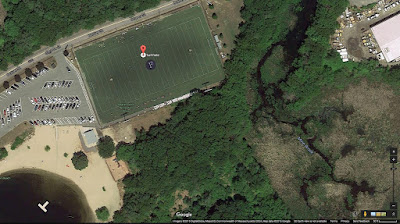
Beaver Pond / Chilson Beach at 450 Beaver Street, Franklin, Massachusetts

Located at 450 Beaver Street, the Synthetic Turf Field was installed sometime around 2003.

•  The Beaver St. synthetic turf field is scheduled to be replaced in the next two years.
•  If the council votes $200k this year, they will hire an architect to design and be ready in 2017 to build.

PROBLEM:  The Beaver Street field is still slated for use in the spring of 2016
Precautions the Town of Franklin should take:  GMAX testing and LEAD testing

QUESTIONS:  
Who was the synthetic turf/carpet and in-fill material supplier for the Town of Franklin's Beaver Street Field?
Is the town liable or the manufacturer for maintenance which effects safety or warranty of the current field? 

WHY GMAX and what is it?  
It is a test to measure the Surface hardness and applies to natural grass and synthetic turf.
GMAX is important because of the increased potential of concussions and  
other injuries cause by impact on a hard surface.

Synthetic turf infill does settle and become compact.  BUT, What is happening at Beaver Street and is MORE concern for safety and what is missing:  the field is very void of any tire crumb rubber infill material that has disappeared over time.  (it disappears through migration: players carry it home, it washes away and also breaks down / erodes over time)
While this infill material is questionable from a chemical standpoint.  Tire Crumb Infill is the material that is supposed to cushion this field.  As of January 2016 the field seemed VERY hard and is void of crumb rubber. There are also flooding issues as documented in the photos below.


It is assumed this all happened because:
•  the "no maintenance" fallacy peddled by synthetic turf companies lead to the Town of Franklin doing "no maintenance" but, indeed, synthetic turf suppliers have full maintenance brochures full of additional equipment needed.

According to one supplier: www.fieldturf.com/maintenance
•   GMAX testing multiple times a year to ensure a safe, properly cushioned surface
•   Field brushing to keep synthetic carpet "grass" fibers standing/ keep from matting
•   Field sanitation using harsh chemicals


Artificial turf collects many unwanted ferrous objects. Metal objects are easily deposited in synthetic turf, creating hidden dangers for the athletes who use the field. Examples of artificial turf metal field contaminants that are easily dropped in artificial turf fields are bobby pins, safety pins, nails, instrument components, buckles and other metal objects from uniforms or band costumes. The six foot tow behind the field magnet will pull these metal objects up and out of the artificial turf.  Protect your athletes with this powerful field magnet for artificial turf. - See more at: http://www.sportsturfnw.com/field-magnet-for-artificial-turf/#sthash.bLDGPQ2r.dpuf
Now for the important question:
WHY LEAD testing for Franklin? and HOW?
 
WHY:
•  Various Federal Agencies state: NO LEVEL of Lead is safe for Children

•  The Beaver Street field was installed prior to the  

http://www.ceh.org/lead-in-artificial-turf/
The Center for Enviromental Health will screen your samples for free. 
***************
Please watch their video about lead in TURF:   
http://www.ceh.org/lead-in-artificial-turf/ 
***************
NOTE: CEH is a non-profit and donations are encouraged!

Sending in a sample is easy!

Your sample should consist of at least six blades.  Collect any loose blades scattered on the turf surface. If those are not available, cut or pull some blades from an area of turf from an area that will not impact the usability of the field. Put the blades in a small bag (for example, a ziplock bag) or envelope. Some turf has two different blade types (often “straight” blades with “curly” blades underneath); if so, send us a sample of both. If there are lines or logos that are different colors you are welcome to send us a sample of each color.  There is no charge for this screening.  We will provide screening results within two weeks of receiving your sample.
Send samples to:
Center for Environmental Health
2201 Broadway, Suite 302
Oakland, CA 94612
Attn: Matt


When talking to the Town of Franklin and fellow parents: 

Is the investment and cost of synthetic turf better than organically treated, properly maintained native grass?


Thursday, January 14, 2016

Will California Play Fair with Synthetic Turf?


California has been passed the ball -- to conduct a realistic and credible study of tire crumb synthetic turf.
Does the government have what it takes?
​The following is a chronicling of its progress, (and history):